Description
PVA TePla Plasma Pen Atmospheric High Density Plasma Cleaning Etching System
Used, working condition.
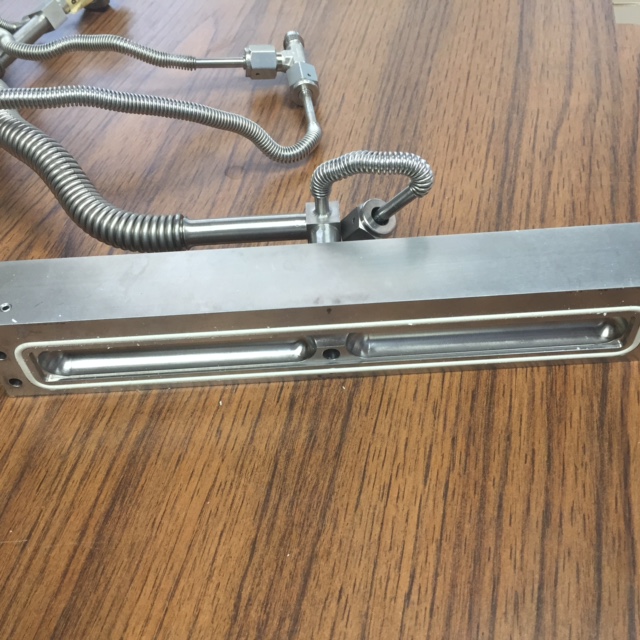
Configuration: PlasmaPen Main Unit, PlasmaPen Tip/Nozzle with Cable, Power Cord, Foot Pedal Control, Fume Extrator Attachment Hose and PlasmaPen Adapter, Used external Air Filter, New Air Filter Kit.
Info from OEM for your reference.
The PlasmaPen™ is a patented atmospheric plasma system used to solve surface preparation problems. Plasma cleaning is the process of removing all organic matter from the surface of an object through the use of a ionized gas called plasma. The PlasmaPen™ produces high density plasma with a low heating effect, giving it the ability to clean and activate the surfaces including low melting point polymers. Our worldwide customer base uses the PlasmaPen™ for a broad range of applications that span the Life Science, Electronics and Industrial markets.
The PlasmaPen™ cleans and activates the surface of materials promoting wettability of potting compounds, adhesives, inks, paints and dyes. Surface cleaning with the PlasmaPen™ ensures reliable wire and die bonding for semiconductor packaging. It has shown particular success in adhesion promotion of anisotropic conductive film (ACF) used in flat panel display manufacturing.
The patented design of the PlasmaPen™ keeps voltages and current safely away from the plasma jet. This means that the user is not exposed to potentially dangerous voltages and surfaces are not subjected to damaging filamentary discharges. The cleaning process is an environmentally safe process as there are no harsh chemicals involved. Plasma often leaves a free radical on the surface being cleaned to further increase the bondability of that surface.
Atmospheric plasma is generated under atmospheric pressure conditions. PVA TePla’s atmospheric plasma is used to clean and modify the surface properties of a material in the absence of any electrical charge. PVA TePla’s design allows compressed air to be the standard treatment gas for most applications and provides for a very low cost of ownership. Other gasses can be utilized depending on the specific application
The PlasmaPen™ can be used manually or remotely through host automation. It is ideally suited to in situ treatments enabling rapid in-line processing, eliminating any activation lifetime issues. Process gasses are flowed through the pen, activated and ejected through the nozzle. PVA TePla’s design allows compressed air to be the standard treatment gas for most applications and provides for a very low cost of ownership. Other gasses can be utilized depending on the specific application.
Impurity/Contamination Removal
Low pressure plasma cleaners are an economical way to uniformly, safely, and completely plasma clean. Removing contaminants from the surface of treated substrates without affecting the bulk material properties.
Plasma processing provides significant advantages over other surface cleaning techniques.
It works for a large range of materials (metals, plastics, glass, ceramics, etc).
It’s the environmentally friendly choice. Plasma cleaning eliminates the need for hazardous chemical solvents. Significant cost savings can be gained without the need for having to address the environmental hazards of other processing methods.
Where solvents can leave a residue after processing, plasma cleaning is able to provide a thoroughly residue-free end product. The processing eliminates mold-releasing agents, anti-oxidants, carbon residues, oils, and all varieties of organic compounds.
Plasma Sterilization
A plasma cleaner is your best solution for the removal of microbial contamination. Many medical and manufacturing facilities depend on plasma as it vastly outperforms aggressive surfactants and organic solvents. It provides a level of uniformity and thoroughness that other sterilization methods simply can’t compete with.
Technical Data
– Width of treatment band 3 – 10 mm (configurable)
– Service Interval 1500 hours (gas dependent)
– Standard Cable Length 3 m – 6 m (9 – 18 ft.)
Requirements
– Electricity : 220-240 VAC, 1 phase, 50/60 Hz (2 amps max)
– Operating Air Supply : Compressed air (6 Bar, 88 psi), 1275 liters/hour (45cf3/h)
– Other Gases : Can also be used with N2, N2/H2, O2, CO2, He gases
– Weight 25 kg / 55 lbs
Features
– High density plasma in contrast to corona discharge
– No electrical current or filamentary streamers in the plasma jet
– Broad material application capability
– Low thermal load allows treatment of low melting point polymers
– Simple host automation integration
– Low environmental impact (no chemicals, primers or vacuum)
– Onboard systems monitoring and diagnostics Applications
Possible Applications of the Plasma Pen
Adhesion Promotion of:
Anisotropic Conductive Film (ACF) – FPD assembly
Polymer adhesive bonding
Inks, dyes and paints
Potting, over mold and under-fill compounds
Bio Materials
Critical Cleaning and Biological Sterilization:
Wire and Die Bond pads
Fiber Optic Cables
Weld Lines
Packaging, caps and closures
Connectors
Optics
PlasmaPen™ usage can be found in the following markets:
Chip scale devices
Electronics packaging
Flat panel displays
Textiles
Life Science and Medical device products
Automotive, Aerospace and Nautical parts
Wires, cables, fibers
Toys and consumer goods
Window/glass manufacturing
Optional Accessories Available
Robotic operation (Multi Axis or X, Y & Z)
Multiple plasma jet array
Foot pedal
Custom fixtures
Plasma detection
Secondary gas cooling
Ventilation hood
Calibration equipment
Full onsite service maintenance contract
Plasma pulsing and secondary gas cooling
Safety Certification Standards
Independently laboratory tested:
– CSA/CE certified
– EN 61010
– EN 61326
The items are subject to prior sale without notice. These items are only for end users.
SSEB380