
Description
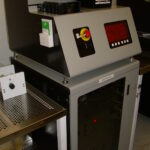
Panalytical EPSILON 5 Wave Dispersive X-Ray Spectrometer xrf Minerals ore assay
COMES WITH CHILLER AND AUTOSAMPLER
COMES WITH CHILLER, COMPUTER SYSTEM, XRF, CABLES, MANUALS, ETC…
A fully integrated X-ray fluorescence (XRF) spectrometer, the Epsilon 5 combines advanced elemental excitation capabilities with sophisticated instrument control and analytical software. Epsilon 5 provides high-performance trace element analysis for industry, research and development applications, as well as being a cost-effective option for commercial analytical laboratories.
A unique and patented EDXRF system design
Epsilon 5 is a unique high-resolution energy dispersive X-ray fluorescence spectrometer specifically designed to deliver enhanced sensitivity and accuracy with significantly reduced backgrounds. A combination of optimized Cartesian-geometrical design for lower backgrounds and extended K line excitation 100 kV X-ray capability technology, make the Epsilon 5 a powerful instrument. The result is superior and often shows sub-ppm detection limits for mid to heavy elements (Fe – U).
Improved trace-level quantification of heavy elements
Epsilon 5 excels when measuring medium to heavy elements. This is largely due to an enhanced X-ray excitation design. By definition the K-line of any element is the optimal spectral line to measure because of its superior sensitivity and reduced spectral interference. Combining high excitation voltages, up to 100 kV, with a matching 100% efficient Ge solid-state detector, the Epsilon 5 extends the range of K-line excitation throughout the heavy elements, including the rare earth elements.
Use of K-series lines for heavy elements
Traditionally in XRF, heavy elements are analyzed using their L-series spectral lines. This is because of restrictions imposed on using K-lines by inadequate excitation voltages, sub-optimal detector efficiency and, in the case of WDXRF, poorer dispersion. However, the main problem with using L-lines is that they lie in crowded parts of the spectrum, commonly overlapped by lines of major elements. They also have relatively low sensitivities. A comparison with typical WDXRF systems reveals the Epsilon 5 has superior performance for elements ranging from molybdenum to the rare earth elements.
Non-destructive analysis
The Epsilon 5 exhibits very low sample heating or X-ray damage due to a combination of low power and polarized (Cartesian geometry) optics. The absence of sample heating means that delicate organic samples, foils and filters can be measured repeatedly without inflicting any damage.
Analytical EDXRF software package
Epsilon 5 software is the XRF analysis software platform that is used with PANalytical’s range of Epsilon 5 EDXRF systems. The software offers all the functions required to set up and operate an Epsilon 5 system. The analytical program assembly is greatly facilitated by the high degree of intelligence built into the software, allowing users to benefit from half a century of applications expertise. Daily XRF analysis is a routine task that can be readily carried out by inexperienced personnel after a minimum of instruction. Many features are present to enhance the usability of the software.
Technical Specifications
General
Sample Changer Type
Fully integrated X-Y sample changer, that can accomodate up to 133 samples
Sample Types
Solids, fused beads, filters, pressed/loose powders and liquids
Usability
Ready for full-scale automation
Excitation
X-ray Generation
X-ray generation up to 100 kV (extending elemental K-line excitation); X-ray generation up to 600 W of power (non heating ideal for delicate samples)
X-ray Tube Technology
Patented X-ray tube technology (Gd or Sc/W anodes)
Optics
Detector
100 % high-resolution efficient PAN 32 Ge detector
Path Geometry
Polarized (Cartesian geometry) path with up to 15 secondary targets (9 are standard)
Analytical EDXRF software package
Technical Specifications
General
Sample Changer Type
Fully integrated X-Y sample changer, that can accomodate up to 133 samples
Sample Types
Solids, fused beads, filters, pressed/loose powders and liquids
Usability
Ready for full-scale automation
Excitation
X-ray Generation
X-ray generation up to 100 kV (extending elemental K-line excitation); X-ray generation up to 600 W of power (non heating ideal for delicate samples)
X-ray Tube Technology
Patented X-ray tube technology (Gd or Sc/W anodes)
Optics
Detector
100 % high-resolution efficient PAN 32 Ge detector
Path Geometry
Polarized (Cartesian geometry) path with up to 15 secondary targets
Valid Time: Subject to prior sale without notice.